
Practical Gardening Knowledge
Garden guide
Healthy hedges, blooming roses, fragrant beds and a garden full of life – practical knowledge from gardening work in Zurich, organised by topic.
Pruning & maintenance
5 TopicsTrimming hedges
Good trimming lets light into the hedge and encourages dense growth.
The right shape
A rectangular hedge is easy to trim, but can become bare at the bottom due to a lack of light. A trapezoidal hedge – wider at the bottom than at the top – or an oval shape lets more light reach the lower leaves.
Regularly and with care
Regular trimming suited to the plant species encourages branching. Before each trim, check whether birds are nesting in the hedge and leave occupied nests undisturbed. Heavy pruning should take place outside the breeding season; light maintenance trimming is only appropriate if it does not disturb the animals.
Native hedge plants
Hornbeam, yew, Cornelian cherry, privet, hawthorn and barberry are good options for a natural hedge. The choice depends on the location, available space and desired growth habit.
Caring for roses
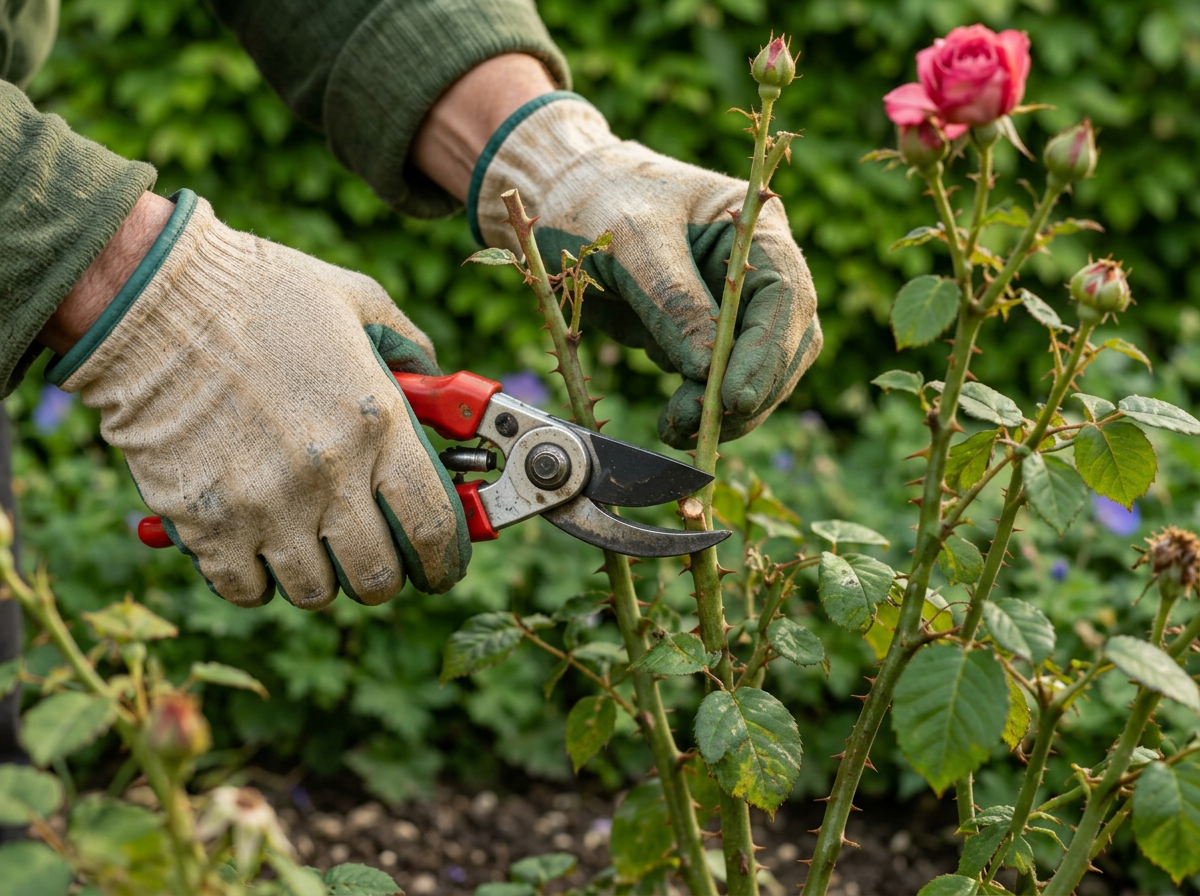
The right pruning method depends on the rose group. Annual pruning can prevent ageing and encourage new shoots at the base; wild roses and ramblers, on the other hand, do not need pruning every year.
Floribunda roses
Remove dead and diseased wood. Shorten the remaining shoots to around four to seven buds; old branches can be removed at the base. These buds are the points from which new shoots grow.
Hybrid tea roses
Prune similarly to floribunda roses, but a little more heavily: cut the remaining shoots back to around three to five buds.
Shrub roses
Focus on thinning out and removing dead or crossing shoots. For repeat-flowering varieties, removing faded flowers encourages further flowering.
Climbing roses
Prune sparingly and remove older shoots at the base when necessary. Flowering habit and variety determine which shoots should be retained.
Pruning fruit trees
A balanced crown combines healthy growth with good fruit production.
Winter or summer pruning?
Winter pruning after leaf fall generally encourages shoot growth. Summer pruning can slow vigorous growth or help shape young crowns. The right timing also depends on the type of fruit, age and condition of the tree.
Pruning at planting and formative pruning
For a young tree, the focus is on establishing a stable crown framework. Pruning at planting is usually carried out in spring, even after autumn planting. During formative pruning, upright shoots and competing branches are removed to allow a balanced crown to develop.
Maintenance and rejuvenation
Maintenance pruning keeps fruit production and growth in balance and renews old fruiting wood. Trees that have been neglected for a long time may need rejuvenation pruning. Major interventions should be professionally planned; any new water shoots will require further care afterwards.
Lawn care
A dense lawn comes from proper mowing, fertilising and watering – not from doing as much of each as possible.
Mowing correctly
Mow regularly and remove no more than one third of the grass blade length with each cut. A cutting height of around 4 to 5 cm, or somewhat higher in shade and dry conditions, keeps the lawn resilient. Sharp blades prevent frayed grass tips.
Watering in dry conditions
Water infrequently and thoroughly rather than a little every day. Early morning is best, so the water can soak in before it evaporates and the grass blades can dry during the day.
Scarifying and overseeding
Where there is a lot of moss and thatch, scarifying in spring or late summer during weather conducive to growth can help. Afterwards, reseed bare patches and keep them moist.
Autumn and winter
With good preparation, your garden will get through the cold season safely.
Making good use of leaves
Remove leaves from the lawn to prevent it from rotting – under hedges and on beds, they can remain as natural soil protection. A pile of leaves in a quiet corner is a welcome home for a hedgehog.
Autumn planting
Autumn is an ideal time to plant trees, shrubs, hedges and many perennials. The soil is still warm, and the plants can establish their roots well before spring.
Winter protection
Place sensitive potted plants in a sheltered position and insulate their pots. Drain garden water pipes in good time. Water evergreen plants on frost-free days during dry periods.
Beds & planting
5 TopicsPerennials and beds
The right plant in the right location saves maintenance, water and frustration.
Location first
Light, soil and moisture determine whether a perennial thrives. Choosing plants to suit the conditions reduces the need for fertiliser, water and plant protection.
Cutting back thoughtfully
Many perennials can be left standing over winter: seed heads provide food for birds, and hollow stems offer insects a place to overwinter. They are then cut back in late winter before new growth begins.
Dividing and rejuvenating
If clumps become bare in the centre or stop flowering well, dividing them is worthwhile – usually after flowering for spring-flowering plants, and in spring or autumn for summer- and autumn-flowering plants.
Spring flowers and pockets of bulbs
Crocuses, grape hyacinths and wild tulips bring colour in March, when the beds are still empty.
Planting in autumn
Flower bulbs are planted from September to December, usually at a depth three times the height of the bulb. In groups of 15 to 30, the flowers will later look more natural than in rows.
Allowing plants to naturalise
Crocuses, grape hyacinths, wood forget-me-nots and wild tulips multiply on their own if they are left to die back undisturbed: foliage and seed heads are left standing, and mowing takes place only six to eight weeks after flowering.
Protecting against rodents
Mice readily eat tulip bulbs, but rarely eat daffodils, crown imperials or glory-of-the-snow. Vulnerable bulbs are planted in wire baskets; in lawns beneath trees, these create a pocket of bulbs that becomes denser each year.
Fragrant garden
Fragrance makes the garden a sensory experience – and many fragrant plants also provide forage for bees.
Fragrance throughout the year
Early in the year, daphne and violets provide fragrance, followed by lily of the valley and lilac in May, woodland sage, calamint, hyssop and anise hyssop in summer, and ivy-leaved cyclamen in late summer. This gives the garden fragrant flowers from March to October.
The right placement
Fragrance works best where you can really appreciate it: beside seating areas, paths and the front door, close to the ground or at eye level. On warm afternoons and in the evening, the scent rises particularly strongly – a spot on the west side becomes a fragrant outdoor room in the evening.
Less fertiliser, more fragrance
Many fragrant plants prefer relatively nutrient-poor, well-drained soil. Too much nitrogen produces lush leaves instead of fragrant flowers. So fertilise sparingly, avoid waterlogging and cut the plants back short after cutting – this keeps them compact and flowering freely.
Edible garden
Berries, herbs and fruit within easy reach – an edible garden is worthwhile even on just a few square metres.
Berries that crop reliably
Currants, gooseberries, raspberries and blackberries also thrive in partial shade and small beds; blueberries need acidic, humus-rich soil. Raspberries bear fruit on two-year-old canes: after harvesting, the old canes are removed and the young shoots are tied in at intervals of 10 to 15 cm.
Fruit for small gardens
Dwarfing rootstocks, columnar forms, and half-standard and low-stem trees bring apples, pears and quinces to even a few square metres. Strawberries and currants thrive in large pots if watered regularly.
Only eat what you know
Not everything that looks like a berry is edible: yew, laburnum, lily of the valley and cherry laurel are poisonous. If you have children, it is worth planting only familiar species. Use only the stalks of rhubarb; the leaves belong in the compost bin.
Raised beds and containers
Raised beds and large pots bring vegetables and herbs onto terraces and into gardens with heavy soil – filled correctly, they last for years.
From coarse to fine
Coarse branches at the bottom, leaves and grass clippings above, and 25 to 30 cm of a good soil-and-compost mix on top. This makes the structure free-draining and saves soil. Fresh wood decomposes in the first year and settles – heavy feeders such as cabbage, courgettes or potatoes are suitable here, with additional fertiliser applied later.
Containers: water and weight
A container with a diameter of 40 cm needs watering daily on hot days – with a drainage hole, a layer of expanded clay for drainage and a saucer without standing water. Bear the weight in mind: 100 litres of wet soil can easily put 150 kg on the terrace.
Position and renewal
Herbs, strawberries and currants need at least five hours of sun; chives and parsley also cope with partial shade. Replace the soil in containers every two to three years – pots lack the natural nutrient cycle.
Nature & life
3 TopicsA wildlife-friendly garden
A garden can be beautiful and valuable to birds, hedgehogs and insects at the same time.
Native plants
Native shrubs and wild perennials provide food for many insect species that find little use for exotic ornamental shrubs and trees. Even small areas, such as a wildflower corner, make a difference.
Create habitat features
Piles of branches, dry stone walls, stone piles and leaves beneath hedges provide shelter for hedgehogs, lizards and insects. A little “untidiness” in the right place is intentional.
Recognising invasive non-native plants
Species such as cherry laurel, butterfly bush or Armenian blackberry displace native plants. The sale of several invasive species has been banned in Switzerland since 2024. We are happy to advise on suitable alternatives.
Beneficial organisms and wildlife
Hedgehogs, wild bees, birds and ground beetles keep the garden in balance – they need habitat features more than flowers.
Habitat features rather than tidiness
A pile of branches about one metre in diameter, a stone pile with a sandy patch and a corner of leaves beneath the hedge are enough to provide winter quarters for many animals. Hedgehogs are reluctant to travel far – a 10 × 10 cm opening in the fence connects neighbouring gardens.
Maintaining nesting aids correctly
Nesting aids with holes for wild bees should be kept dry, face southeast and be positioned one to two metres above the ground. Replace or clean bamboo tubes and nesting blocks after the bees emerge in autumn, otherwise parasites and fungi will take hold. Rinse a birdbath daily – it is a place where infections can spread.
Working without poisons
Aphids on roses decline by themselves after a few days if ladybirds, lacewings and hoverfly larvae are present; a strong jet of water or a soap solution provides additional help. Slug collars, early-sprouting berry varieties and daily hand-picking work more reliably against slugs and snails than scattered pellets.
Ponds and water in the garden
A small pond transforms the garden: it cools, reflects light and attracts dragonflies, frogs and birds.
Position and depth
Four to six hours of sun are favourable; the shallow marginal zone should be 20 to 30 cm deep, and the centre 40 to 60 cm. If you want fish or frogs to overwinter, plan for 80 cm so the pond does not freeze solid. A pond directly beneath trees means leaf-clearing work in autumn, and you should check where utility lines run before digging.
Zones rather than fish
A shallow-water zone with rushes and water plantain, a deep-water zone with a water lily – without fish, the water stays clear and frogs, dragonflies and newts can reproduce, because fish eat spawn and tadpoles.
Maintaining water levels
In summer, a pond loses several litres a day through evaporation. Top it up with rainwater from a water butt; use tap water only sparingly, because it introduces nutrients and lime, encouraging algae. When water evaporates, the nutrients remain – regular topping up keeps their concentration low.
Overwintering
Stretch a leaf net over the pond in autumn – rotting leaves deprive the water of oxygen. A floating wooden block, a PET bottle filled with sand or a bundle of thin twigs (brushwood) keeps an ice-free opening so that decomposition gases can escape and oxygen can enter the water; check this opening weekly and clear away snow so that light reaches the aquatic plants. Never break the ice by striking it – the shock waves are fatal to frogs and fish; instead, pour warm, not boiling, water onto the ice. During prolonged frost, run a small pump or a solar aerator for a few hours a day.
Soil & water
2 TopicsImproving soil and composting
Good soil stores water and nutrients naturally. Once established, it works for you – with compost, mulch and little digging.
Composting that works
Alternate green material (grass clippings, vegetable scraps) and brown material (leaves, twigs, straw), keep it as moist as a wrung-out sponge and shred bulky material into pieces of 10 to 20 cm. Compost is mature after six to nine months: dark, crumbly and smelling of woodland soil.
Mulching instead of digging
A layer of grass clippings, leaves or composted bark three to five centimetres thick retains moisture, suppresses weeds and feeds soil life. Dig only where the soil is compacted – otherwise, the layers and fungal networks remain intact.
Liming and fertilising as needed
Have a soil sample tested before fertilising; this is available at low cost through the cantonal advisory service. Apply lime only following analysis, and usually no more often than every three to five years. Too much nitrogen produces soft, vulnerable shoots – mature compost is sufficient for most beds.
Watering and saving water
Water less often but thoroughly – this encourages roots to grow deep rather than near the surface.
Watering correctly
Ideally, water early in the morning, using about 15 to 20 litres per square metre so that the top 15 to 20 cm are moistened. At midday, much of the water evaporates; in the evening, leaves stay wet for a long time. Water directly onto the soil, not over the leaves.
Drip hose, water butt, cistern
A drip hose beneath the mulch layer delivers water to the roots and uses significantly less than a sprinkler. A water butt or cistern reduces demand on the mains supply; check municipal regulations in advance for infiltration swales and cisterns.
Watering new plants
Young trees, shrubs and perennials need scheduled watering in their first year: during hot weather, 10 to 20 litres per tree per week, at the edge of the tree's soil circle rather than at the trunk. A watering rim and five centimetres of mulch retain moisture; drain pipes and pumps in autumn.
Built & designed
2 TopicsVertical Greening
Green walls, fences and climbing supports make use of vertical space – for privacy, cooling and habitat.
Climbing supports instead of clinging roots
Self-clinging climbers such as ivy and Virginia creeper attach directly to walls and belong on solid, unrendered masonry. For rendered and insulated façades, an offset structure of tensioned wires or trellises is the safe choice: a 10 to 20 cm air gap allows the wall to dry, and the render remains intact.
Choosing plants by compass direction
Ivy, climbing hydrangea and clematis suit north-facing walls; honeysuckle and clematis thrive on east- and west-facing walls, while climbing roses flower on south-facing walls. Evergreen ivy provides privacy even in winter, while deciduous climbers let the sunshine through.
Containers, fences and edible climbers
On a balcony or terrace, a tall container with a trellis is sufficient. Nasturtiums and runner beans climb quickly and are edible; woody plants such as honeysuckle need secure supports. Tie in new shoots regularly – loose shoots can easily snap off in storms.
Paths, paved areas and terraces
Paths and paved areas bear loads, guide you through the garden and must shed water – a gradient of one to two percent determines whether puddles form.
The sub-base is half the job
Paving only lasts on undisturbed, compacted ground: a 25 to 40 cm frost-protection layer compacted in stages, 5 cm of bedding, and paving with joints. Kerbstones or lateral restraints prevent the stones from shifting over time.
Letting water through
Open sand joints, permeable jointing mortar or grass-jointed paving keep the surface permeable. In many municipalities, rainwater should soak into the ground on site – permeable construction is then the simplest solution and needs no additional drain.
Heat and edging
Dark paved surfaces become hot in summer; light-coloured paving, a pergola covered with climbers or planting around the edges keep temperatures manageable. A narrow planting pocket between the paving and the bed absorbs splashing water and greens the edge.
The gardening year at a glance
The most important tasks by season – as a guide for gardens in the Zurich area. Weather conditions and plant species determine the exact timing.
Spring (March–May)
- Cut back perennials and grasses
- Prune roses when the forsythias flower
- Scarify and fertilise the lawn
- Prepare and plant beds
- Plant berry bushes and herbs for the edible garden
- Apply mulch three to five centimetres thick to the beds
Summer (June–August)
- Trim hedges to shape after the main nesting season
- Remove faded flowers
- Water thoroughly during dry spells
- Summer-prune fruit trees
- Tie in climbing plants and prune raspberries after harvesting
- Turn compost and keep it moist
Autumn (Sept.–Nov.)
- Plant trees, shrubs, hedges and perennials
- Remove leaves from the lawn
- Plant flower bulbs
- Drain water pipes
- Sieve mature compost and work it into the beds
Winter (Dec.–Feb.)
- Prune fruit trees on frost-free days
- Carry out heavier pruning outside the nesting season
- Check winter protection
- Install climbing supports and trellises
- Clean or replace wild bee nesting aids
- Garden planning for the new year
Frequently asked questions
When can hedges be trimmed in Switzerland?
Maintenance trimming is generally possible all year round, provided no nesting birds are disturbed. Heavy pruning should take place outside the breeding season, roughly from October to February. Check whether nests are occupied before every cut.
When is the best time to prune roses?
The main pruning takes place in spring, when severe frosts are no longer expected – a well-known rule of thumb is when forsythia blooms. In summer, faded flowers and weak shoots are removed.
When should fruit trees be pruned?
Traditional winter pruning takes place after leaf fall on frost-free days and encourages growth. Summer pruning curbs vigorous growth. Stone fruit trees such as cherries are often pruned after harvest.
Which hedge is a good alternative to cherry laurel?
Cherry laurel is considered invasive in Switzerland. Depending on the location, good native alternatives include hornbeam, yew, privet, field maple or a mixed wildlife hedge.
Which plants suit a fragrant garden near a seating area?
Low-growing species such as calamint, hyssop and violets have proved effective right beside paths, with woodland sage and anise hyssop a little further back. Early in the year, daphne and lily of the valley provide fragrance. Location is key: fragrant plants are best appreciated where people pass them – beside a seating area, steps or the front door.
How can I green a façade without damaging it?
On rendered or insulated façades, climbing plants grow best on an offset structure of tensioned wires or wooden trellises with a 10 to 20 cm air gap from the wall. Self-clinging climbers such as ivy or Virginia creeper should only be used on solid masonry without render, as their clinging roots can damage render and insulation. First check whether the structure can support the additional weight when the plants are in full leaf.
How often do I need to water my garden?
As a rule, a thorough watering of around 15 to 20 litres per square metre every seven to ten days is sufficient – it is better to water generously and infrequently than a little every day. Young plants, containers and sandy soils need water more often, while mulched beds need significantly less.
What belongs in the compost – and what does not?
Grass clippings, leaves, twigs, fruit and vegetable waste, coffee grounds and crushed eggshells: alternate green and brown material, keeping it as moist as a wrung-out sponge. Meat and cooked food, diseased plant material, weeds with seeds and larger quantities of ash do not belong in it.
Does a garden path need to be permeable?
In many municipalities, rainwater should soak into the ground on site. Open sand joints, permeable jointing mortar or grass-jointed paving are therefore a simple solution. We clarify your municipality’s requirements before preparing a quote – otherwise, a sealed surface needs an additional drain.
How can I keep slugs and snails away without poison?
Slug collars around individual stems, early-sprouting berry varieties, daily collection in the evening and a diverse community of beneficial organisms work more reliably than scatter treatments. Use pellets only in targeted spots and in small quantities.
Are grants available for removing sealed surfaces or greening?
In the city of Zurich, Grün Stadt Zürich contributes through the «Stadtgrün» funding programme with one-off grants covering 50 percent of the total costs per measure, up to Fr. 1 000 000 – for vertical and roof greening, ecological improvements to outdoor spaces, removal of existing sealed surfaces, tree planting and preservation of existing trees. Maintenance can also be co-funded: the two-year establishment care of a planting scheme and the four-year development care of newly planted trees can be included in the funding on request, but require a separate application. A prerequisite is a nature-friendly design with predominantly native plants – at least 80 % in our case – and no invasive non-native plants. The former programmes «Mehr als Grün» and «Vertikalbegrünung» are now included in it. Important: the application must be submitted electronically through the city’s web portal before construction begins, and the funded measure must be retained and professionally maintained for ten years. Geiser Gartenbau compiles the required documents and submits the applications for you.
Do you also provide regular garden maintenance in Zurich?
Yes. Geiser Gartenbau provides garden maintenance and tree and hedge pruning in Zurich and the surrounding area – as a one-off service or regular maintenance. Contact us for a no-obligation consultation.
Your garden in good hands
Every garden is different. We will be happy to advise you on the right care for your plants.